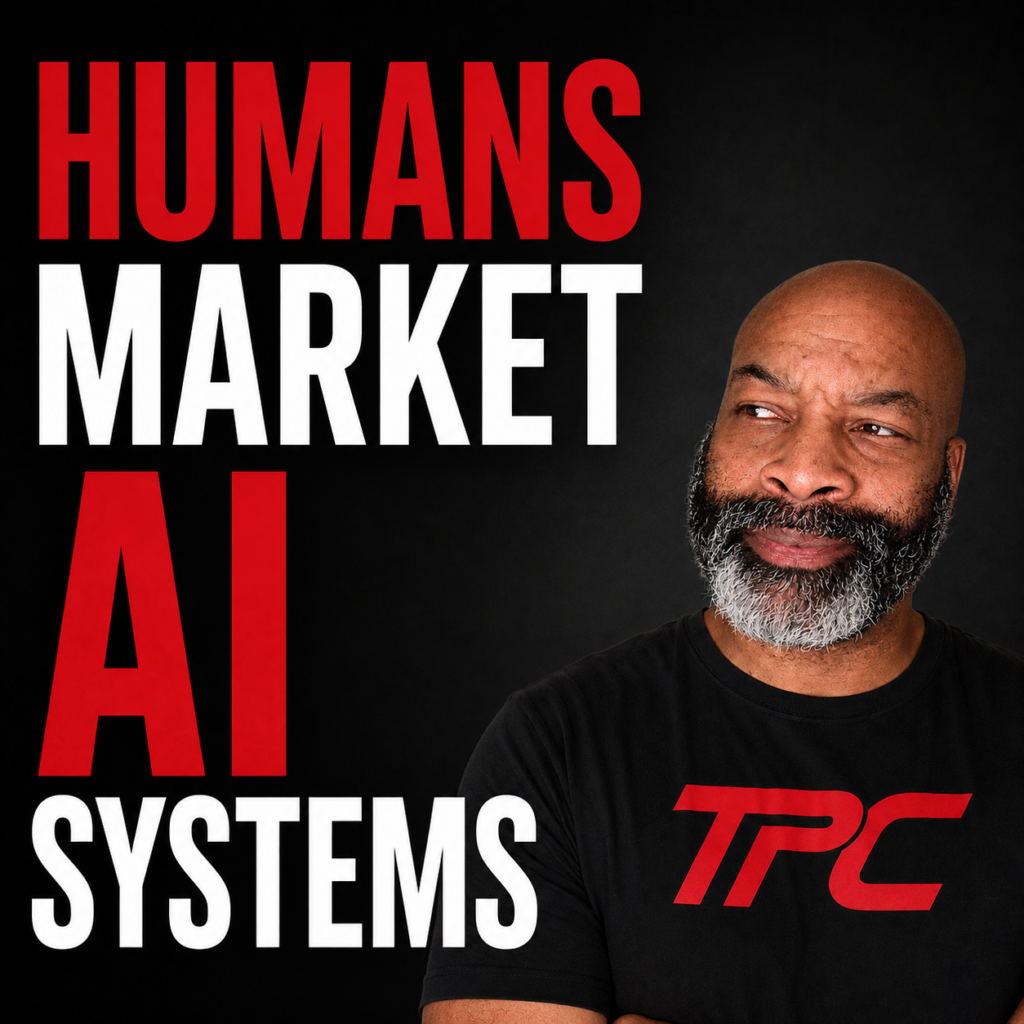
AI marketing systems are everywhere. People promote software that writes emails, creates content, builds funnels, follows up with leads, answers questions, and automates an online business.
The message often sounds simple. Let AI do the work.
But there is something happening in plain sight that gets overlooked.
Humans are still doing the marketing.
The person telling you an AI system can market for you is usually making videos, writing posts, sending emails, running ads, building relationships to get your attention. In other words, a person is actively promoting the system that supposedly handles the marketing.
That does not make AI marketing systems useless. It simply means we should separate what the technology does from what the marketing message sometimes suggests.
AI Marketing Systems Do Not Create Attention by Themselves
AI can handle tasks after a prospect enters your marketing process. It can prepare follow up messages, answer common questions, organize information, suggest content ideas, and help guide leads through a funnel.
The part before that is where the human usually comes in.
A video gets recorded and uploaded.
A post gets published.
Traffic gets purchased or generated.
An advertisement gets created.
A link gets shared where people can find it.
Those actions are marketing. The software may support what happens next, but the initial attention did not appear out of nowhere.
The phrase AI marketing system can sometimes create an unrealistic picture. A person may imagine software searching the internet for buyers, convincing strangers to purchase, and producing commissions with little involvement from the owner.
AI assists parts of a marketing process. It can automate steps within that process, but it does not automatically create an audience.
The Human Usually Starts the Conversation
Marketing begins with getting noticed.
An autoresponder cannot send a follow up email until a lead enters the system. A chatbot cannot answer a prospect who never visits the page. A sales presentation cannot be viewed by a person who never receives the link.
Interest generally begins with some form of human activity.
A YouTube video can introduce the idea. A social media post can get attention. Paid advertising can put an offer in front of a targeted audience. A conversation can lead someone to a website. A blog article can bring a reader into the funnel.
Technology can support all of those activities, but the tool does not erase the need for exposure.
Understanding the difference between automation and marketing gives people a clearer picture of what a system provides.
Automation handles repetitive steps.
Marketing creates awareness, interest, and curiosity.
They can work together well, but they serve different purposes.
AI Can Make Marketing Easier Without Replacing the Marketer
The real value of AI is not total replacement of human effort. Its strength is reducing work that once had to be done manually.
AI can help build an email sequence in minutes.
It can generate video topics when ideas are running low.
It can provide answers to common questions without requiring the owner to type the same response repeatedly.
It can organize leads, summarize information, help create landing page copy, and keep communication flowing after a prospect enters the system.
That can save time and make a process more consistent.
Even with those advantages, the human remains responsible for decisions. The marketer chooses the message, the audience, the offer, the platform, and the source of traffic.
Automation needs people entering the process.
Without views, clicks, visitors, leads, or conversations, there is nobody for the system to follow up with.
Traffic feeds the funnel.
Content creates exposure.
Communication helps build understanding.
AI can make the machinery more efficient, but the machinery needs activity coming into it.
Look at How AI Systems Are Being Sold
One of the clearest examples comes from the people promoting AI business systems themselves.
Look at their activity.
You see YouTube videos explaining the opportunity.
Facebook posts introduce the software.
Short form videos demonstrate features.
Advertisements attract prospects.
Emails bring people back to the offer.
Livestreams, webinars, testimonials, and demonstrations help explain what the system does.
If AI completely handled the entire marketing process by itself, all of that human promotion would be unnecessary.
Yet the promotion continues because attention remains a major part of selling anything online.
The technology may become useful after a prospect enters the process. It can answer questions, present information, follow up, and reduce repetitive work. But getting a prospect interested enough to enter the system begins outside of the automation.
That does not expose AI as a scam or make the technology less valuable. It simply places the tool in the correct role.
A tool can improve a process without replacing the person using it.
The Better Way to Think About AI Marketing
A more accurate description for many of these systems would be AI assisted marketing.
The human attracts attention.
The system captures the lead.
Automation continues the follow up.
The offer gets presented.
The prospect makes a decision.
That description is closer to how online marketing normally works.
Once people understand that process, expectations become more realistic. AI can be used for what it does well for them without turning it into something magical.
People still have to discover the offer.
They have to become interested enough to click.
Trust has to develop along the way.
There must be a reason to pay attention in the first place.
AI can improve communication, speed up repetitive work, and make certain tasks easier to manage. It cannot guarantee views, traffic, interest, trust, leads, or sales.
Those outcomes continue to depend on the complete marketing process.
AI is changing online marketing in a significant way, but it has not eliminated the marketer.
In many cases, the best proof is sitting right in front of us.
The person promoting the AI system is still using human marketing to get people interested in AI.
By the way, AI helped me write this blog post.

P.S. If you’re interested in seeing the online business system I use, you can see how it works here.