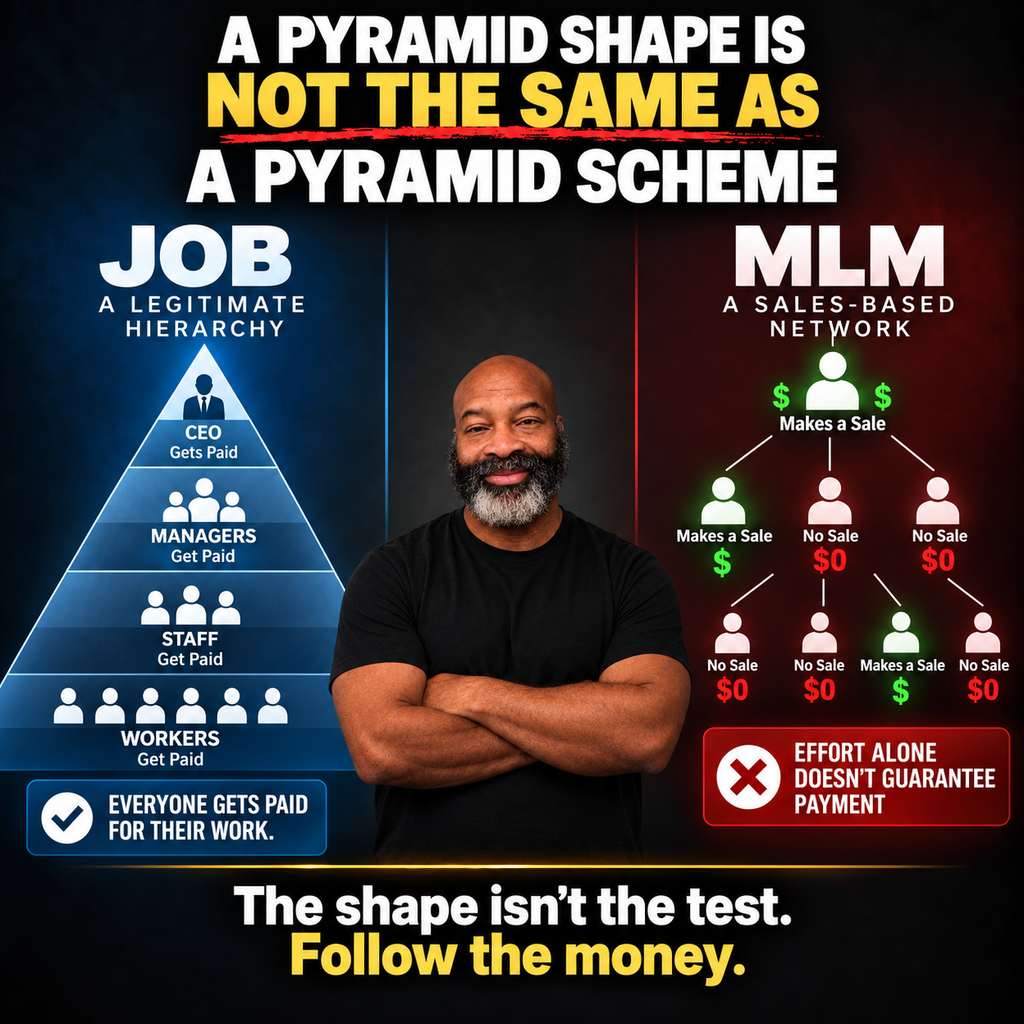
One of the most common responses people in MLM use when someone says their company is a pyramid scheme is, “Your job is a pyramid too.” The reasoning is that a traditional company has a CEO at the top, managers underneath, supervisors below them, and workers at the bottom. On paper, that structure can absolutely look like a pyramid.
But that misses the point. A pyramid-shaped organization is not the same thing as a pyramid scheme. The shape of the organization is not what determines whether something is legitimate. The real question is how people are compensated and what activity actually produces the money.
A Job Hierarchy and an MLM Are Not the Same
In a traditional job, employees are generally paid based on an agreement to perform certain work. An hourly employee gets paid for the hours worked. A salaried employee gets paid according to the terms of the position. There may be several levels of management above that employee, but the employee normally does not have to recruit another worker, generate a sale, or build a downline before receiving their paycheck.
That is where the comparison with MLM starts to fall apart.
In MLM, someone can spend hours posting online, making videos, calling prospects, following up, giving presentations, attending meetings, and learning the products, yet still earn nothing if they do not generate the sales or qualifying volume required by the compensation plan. Their effort alone does not guarantee payment.
That does not automatically make MLM bad or illegal. Commission-only salespeople outside of MLM can experience the same thing. They can work all day and make nothing if no sales happen. The important point is that this is a fundamentally different compensation arrangement from a regular hourly or salaried job.
The Real Question Is How the Money Moves
This is why saying “your job is a pyramid too” does not really answer the criticism.
If someone believes an MLM is a pyramid scheme, the useful question is not whether the organizational chart looks triangular. The useful question is where the money comes from.
Are people earning primarily from legitimate product or service sales? Does the compensation plan encourage selling to genuine customers? Are participants being rewarded mainly for recruiting additional participants? Are people making purchases because they actually want the product, or because they need those purchases to remain qualified for commissions, bonuses, or advancement?
Those questions tell you far more about the business than the shape of the organization ever could.
MLM Does Not Automatically Mean Pyramid Scheme
There is also a mistake on the other side of the discussion. Just because MLM operates differently from a regular job does not mean every MLM is automatically an illegal pyramid scheme.
A legitimate direct-sales or network-marketing company can have uplines, downlines, commissions, and multiple levels of compensation. The existence of those things alone does not settle the issue. What matters is how the compensation system operates and what behaviors it encourages.
That is why both sides can oversimplify the discussion. Saying “it has multiple levels, therefore it is a pyramid scheme” is too simplistic. Saying “your job has multiple levels too, therefore MLM cannot be a pyramid scheme” is also too simplistic.
The structure alone does not answer the question.
The Biggest Difference Is Payment for Work
This is the distinction that I think MLM promoters should be more willing to acknowledge.
A worker at a traditional job can usually complete the work required by the employer and expect to receive the compensation they were promised. Someone in an MLM or another commission-based business can work extremely hard and still make zero dollars because the activity did not produce a qualifying sale.
That difference matters.
It does not mean the MLM participant did not work. It does not mean the opportunity is automatically illegitimate. It simply means that the person is working under a performance-based compensation model rather than a guaranteed wage model.
Once you understand that distinction, the “your job is a pyramid too” argument becomes unnecessary.
A Better Response to the Pyramid Question
Instead of responding to criticism by pointing at a traditional company and saying, “That’s a pyramid too,” a stronger response is to examine the actual business model.
If someone says an MLM is a pyramid scheme, ask what specifically about the compensation plan concerns them. Look at how commissions are generated, whether products or services have genuine customers, what role recruiting plays, whether personal purchases are required, and what participants actually have to do to qualify for compensation.
That turns the conversation away from slogans and toward the actual economics of the business.
A company can have a CEO, executives, managers, supervisors, and thousands of workers and still have nothing to do with a pyramid scheme. An MLM can have several levels of distributors and still require a closer look before you can determine how the business really operates.
The diagram does not decide it.
The Shape Isn’t the Test. Follow the Money.
The strongest way to understand the difference is simple: stop looking at the triangle and start looking at the money.
Who pays whom? What has to happen before someone gets paid? Are commissions generated through actual sales? What does the compensation plan encourage people to spend their time doing?
Those are the questions that matter.
So the next time someone says, “Your job is a pyramid too,” remember that a hierarchy and a pyramid scheme are not the same thing. A job can be shaped like a pyramid without operating like one.
The shape isn’t the test. Follow the money.

P.S. Want to follow the money for yourself? Take a look at Exitus Elite and see how the products, compensation, and system are actually structured.